Career Motivators: the Story for Employers
Sunday Star Times 30 Jan 2012
Career Trends 2012: Part 2 – the story for Employers
Employees in New Zealand are increasingly looking to develop their careers, and the under-30s (Gen Yers) are particularly keen to fast-track their careers according to New Zealands’ first Career Trends survey conducted for Sunday Star times by Career Analysts.
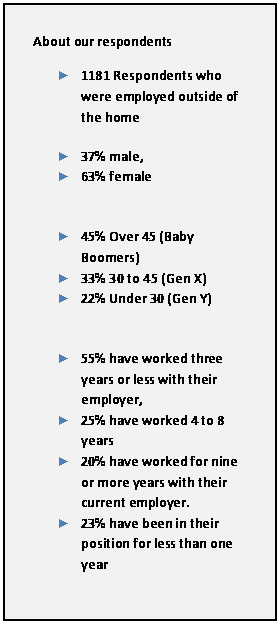
The survey, completed by over 1100 respondents tracked responses to key career trends, including attitudes to flexible work practices and highlighted some key differences in the career ‘wants’ of men and women and across generations.
Pace of change in the world of work is accelerating.
 There is no doubt that the number of jobs people hold in a life-time is increasing, with a single “employer-for –life” a thing of the past. The Career Trends survey found that younger people have held more jobs in the last five years than those older. While only 27% of all respondents had more than three jobs in the last five years, there were nearly 55% of Gen Yers’ who had more than three jobs in the last five years. There is no doubt that the number of jobs people hold in a life-time is increasing, with a single “employer-for –life” a thing of the past. The Career Trends survey found that younger people have held more jobs in the last five years than those older. While only 27% of all respondents had more than three jobs in the last five years, there were nearly 55% of Gen Yers’ who had more than three jobs in the last five years.
However, don’t write-off those who have had a number of jobs – they may just be looking for the right thing. Interestingly, those who have had more jobs in the last five years also want a faster pace at work and want more career growth.
Wanting more career growth is consistent with findings from engagement surveys that the top driver of satisfaction and engagement is Career Development (Hewitt, 2011 and Towers Watson, 2011). The 2012 Career Trends results align with this but also suggest that challenge, a faster pace, more learning and more responsibility and opportunity are also wanted by the Gen Y’ers in particular.
Untapped Potential for Employers: Gen Y hungry for opportunity
43% of all respondents aged under 30 wanted to take on more responsibility or believed they had “more to contribute to the organisation”, while only 7.4% of the younger respondents wanted less responsibility.
Younger people also had significantly higher leadership aspirations and had aspirations of leading a team or being part of senior management teams in the future. Jonny, a young Gen Y Financial Services Manager in Auckland, typifies this view commenting “A leadership role is certainly the goal. I believe the ability to manage not just the workload, but also people, is a key aspect in developing my career and will no doubt be a large part of success in future years.”
However, a surprising 70% of those over 50 were either not interested in leading a team at all or leading only a small team of people. This fits with the other finding that Baby Boomers were more likely to want to reduce the pace of their work. We found that younger people wanted significantly more career growth and to be fast-tracked in their careers, while the older “baby boomers” in the survey wanted to reduce their workloads and work responsibilities. Employers may need to consider fast-tracking the careers of younger people to ensure they have a leadership pipeline in the future.
 Career Motivators Career Motivators
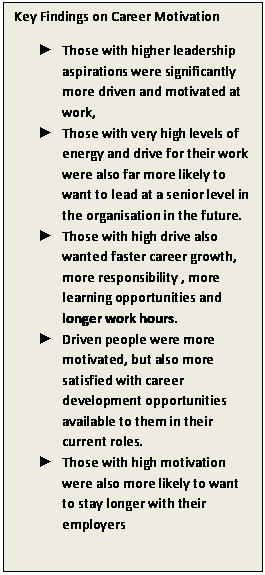
The Career Trends survey highlighted that there were a group of highly motivated employees who showed both higher long term aspirations and a hunger to develop their careers.
Nearly 30% of all respondents were keen to take on “stretch” assignments, and this was particularly significant for the Gen Y respondents. Emily, a 20-something Marketing Executive in Auckland, typified her generation when she says she “ always like to see challenges or opportunities arise, that throw me in the deep-end, that push me to grow and develop not only within my organisation but in my industry too. I recently heard a saying that I love, “when you are comfortable make yourself uncomfortable.””
The 2012 Career Trends Survey showed that those with higher drive wanted faster career growth, more responsibility and were keen to work longer hours.
Finding people with high levels of drive (as found in the 2012 Career Trends Survey) will deliver returns in terms of productivity and performance. Michaela Drum, Registered Psychologist and Managing Director of Added Insight found that drive was the biggest predictor of performance for sales people in a recent study conducted on NZ sales employees.
'Drive is defined as a strong internal motivation and drive to achieve. Individuals driven to achieve are likely to set themselves challenging goals, strive for high standards and high levels of competence. They take their work seriously, seek challenges, and are active, hard workers. '
Career Agility Trends
Those most mobile and open to changing location were unsurprisingly the Gen Y respondents, with those under 30 being significantly more open to other locations than those who were older.
Chelsea a 22 year old Law Intern, currently working in Sydney commented that “Most of my friends consider the opportunity to live and work overseas. They are attracted by the idea that you can gain international experience, earn big money in bigger economies, which means bigger opportunity, all whilst travelling the world. While Europe, Thailand and South America continue to be really popular choices for OEs, Australia has become a really attractive and realistic option for NZ students entering the work force.”
Increasing Demand for Flexible Work Practices
Offering flexible work practices can significantly pay off for employers. Last weeks’ Sunday-Star-Times Career Trends report showed that a large proportion of people were seeking more flexible hours and a shorter week. Working Mom’s Research survey of 50,000 US employees reported by the Corporate Executive Board found that people who are happy with their work-life benefits are also likely to:
- Work 21 percent harder
- Are 33 percent more likely to plan to stay at that organization
What Flexible Work Practices Do Employees Want?
In the 2012 Career Trends Survey, when asked about what they wanted,
- 61 % wanted to work 4 days or less (and were willing to take the resulting pay drop)
- 36% wanted to work 4 days per week
- 29% of males and 25% wanted the opportunity to take a career break at some point
- 21% of males were keen on sabbaticals
- 26% wanted an opportunity for study leave
- 20% were interested in secondments.

Career Development Impacts Engagement & Retention
The 2012 Career Trends survey showed that those who are more satisfied with the career development opportunities in their current role are expected to remain longer. Jo Mills, General Manager of Career Analysts says “We often see individuals leave roles too early – before they have maximised the opportunities that exist in their current role. Career Development helps individuals map their aspirations to their current role, and their future with their employer. This naturally creates longer retention and commitment.”
More than a quarter of all respondents were keen to stay with their current employers for as long as possible, this was consistent across all age groups. While 60% wanted to stay on with their employers for more than 3 years, only 45% of Gen Y were keen to stay more than 3 years with their current employer, so if the under-30’s are to be your future leaders, there is a need to individualise a compelling career proposition for these individuals that could include career breaks, secondments, stretch assignments to retain and motivate these individuals over time. As Jo Mills adds “Being able to see how your career goals, values, talents and interests align with the business, having a clear line of sight of how your career can develop and how your role contributes to the bigger picture, creates that engagement. It would be hard to leave a role/business that offered that!”
When asked what kind of career development they were seeking, 44% of all respondents were interested in mentoring. Mentoring can be a cost-effective career development source for organisations, with win-win benefits for both the mentor and recipient. “Having one of NZ’s leading business as a mentor made a significant difference to the direction my career subsequently took” says James, now a CEO of a globally successful NZ company.
While 60% of all respondents were keen to attend externally run workshops and training, 46% of all respondents were keen for online learning opportunities, which can be a really cost-effective career development solution for organisations which is a growing trend of appeal to employees. Richard Klein, Director of NZ on-line learning specialists Populus says “On line learning in New Zealand is accelerating so long as, it's easy to operate, it can be used any time from anywhere, it's best practice but kiwi, and examples are local and relevant; which is why we are seeing Training On Demand tracking at approx 20% growth each month across many sales, customer service, management, business and people skills training topics.”
Career Development solutions don’t need to be expensive to be effective. The 2012 Career Trends survey suggests that by understanding the career wants and needs of individuals it is possible to customise a career proposition that might include flexible work hours, stretch assignments, mentors or short secondments – all of which can fast-track career growth, impact retention and improve the individual motivation and productivity.
Anne Fulton, Director Career Analysts, delivering strategic career management solutions to organisations in Australia and New Zealand.
|